
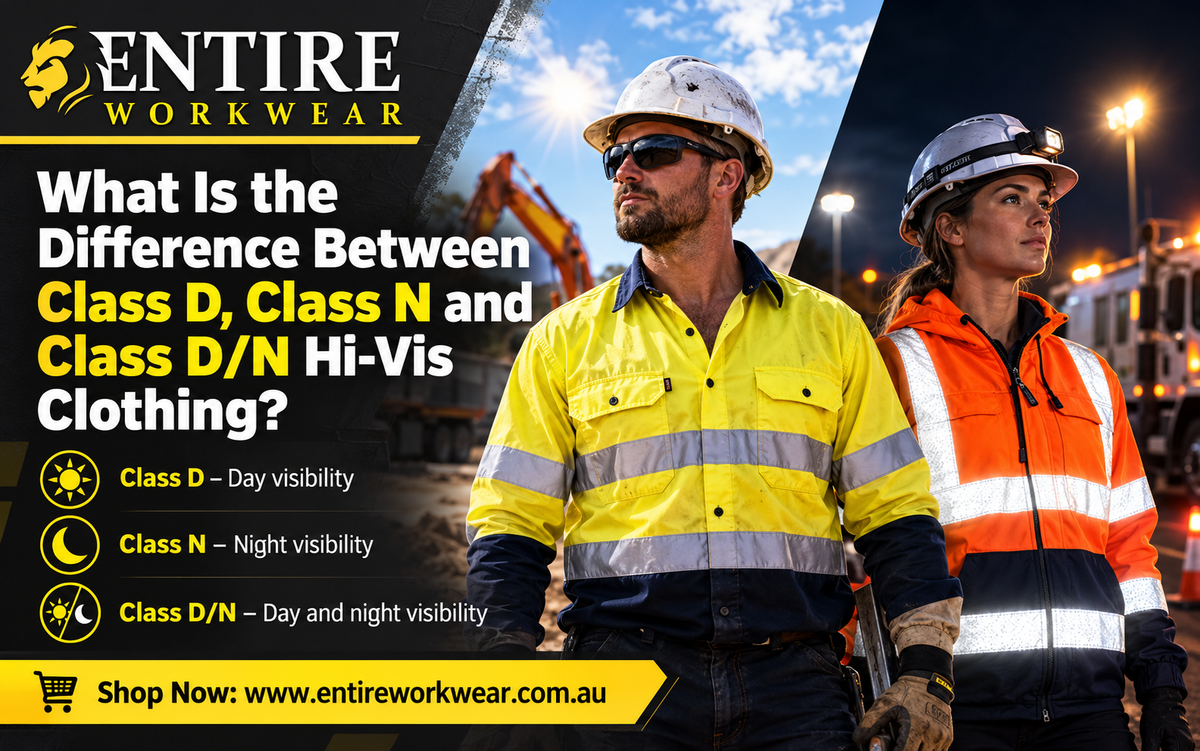
A worker directing vehicles on a busy construction site has different visibility needs from someone working inside a warehouse or maintaining roads after sunset. Although their uniforms may look similar, the level of visibility protection required can vary considerably. Understanding the classifications of hi vis clothing is an important step towards selecting suitable garments for different working conditions.
In Australia, high-visibility garments are commonly identified as Class D, Class N or Class D/N. These classifications describe whether clothing is designed for daytime use, night-time visibility or a combination of both. Knowing the difference helps workers, employers and safety managers make informed purchasing decisions rather than choosing garments based on color or appearance alone.
What Do Class D, Class N and Class D/N Mean?
Class D, Class N and Class D/N are Australian high-visibility garment classifications based on the lighting conditions in which the clothing is intended to provide visibility.
-
Class D (Day): Designed to improve worker visibility during daylight using high-visibility background material.
-
Class N (Night): Designed for night-time visibility using retroreflective material illuminated by appropriate light sources.
-
Class D/N (Day/Night): Combines high-visibility background material and retroreflective components for both daytime and night-time applications.

These classifications help distinguish garments intended for different environments. However, the required clothing must still be selected according to workplace hazards, applicable Australian standards and site-specific safety procedures.
Class D vs Class N vs Class D/N: Quick Comparison
|
Feature |
Class D |
Class N |
Class D/N |
|
Intended use |
Daytime |
Night-time |
Day and night |
|
High-visibility background |
Required |
Not necessarily required |
Required |
|
Retroreflective material |
Not mandatory |
Required |
Required |
|
Main visibility mechanism |
Daylight contrast |
Reflecting directed light |
Both mechanisms |
|
Typical garment examples |
Hi-vis shirts and vests |
Reflective safety garments |
Taped shirts, jackets and overalls |
- The classification tells buyers about the garment's intended visibility performance, not whether it is automatically appropriate for every workplace.
What Is Class D Hi-Vis Clothing?
Class D garments are intended to make workers easier to identify during daylight hours.
They use specially selected high-visibility background materials that provide noticeable contrast against common workplace surroundings. Fluorescent yellow and orange are familiar examples, although compliant materials must satisfy the relevant technical requirements rather than simply appear bright.
Where Is Class D Clothing Commonly Considered?
Daytime garments may be appropriate in environments such as:
- Outdoor construction activities performed in daylight
- Landscaping and grounds maintenance
- Daytime warehouse loading operations
- General site inspections
- Agricultural and maintenance work involving vehicle movement
For example, a landscaping employee operating near mobile equipment during a daytime shift may need a suitable high-visibility shirt. Whether Class D alone is sufficient depends on the workplace's assessment of visibility hazards.
Does Class D Clothing Need Reflective Tape?
Class D classification does not itself require retroreflective tape.
Some manufacturers may add tape to a garment, but this feature alone does not establish Class N or Class D/N compliance. The complete garment design, materials and relevant testing requirements must be considered.
Class D should not be assumed suitable for night work simply because the clothing remains brightly colored.
What Is Class N Hi-Vis Clothing?
Class N clothing is intended for visibility at night when suitable artificial illumination is available.
Its essential feature is retroreflective material, commonly arranged as tape on the garment. Retroreflective surfaces return a significant portion of incoming light towards its source, helping a worker become more noticeable when illuminated by vehicle headlights or other directed lighting.
Unlike daytime visibility, which relies heavily on conspicuous background material, night-time retroreflective performance depends on how light reaches the garment.
When Might Class N Clothing Be Used?
Class N clothing may be relevant to certain night-time activities involving vehicles or equipment, provided the garment meets the applicable workplace requirements.
Potential settings include transport facilities, industrial yards and controlled maintenance operations.
However, it is important to understand that reflective material does not produce its own light. Its effectiveness depends on illumination, garment configuration and viewing conditions.
A reflective garment is not a substitute for proper worksite lighting, traffic management or other safety controls.
What Is Class D/N Hi-Vis Clothing?
Class D/N garments combine the visibility characteristics required for daytime and night-time use.
These garments incorporate high-visibility background material together with compliant retroreflective components. This combination makes them particularly relevant to workplaces where lighting conditions change during a shift.
Consider a maintenance team starting work in the late afternoon and finishing after sunset. Their visibility requirements change as natural light decreases. A correctly selected Class D/N garment can address both daytime and night-time visibility requirements within the conditions for which it is designed.
Why Are Class D/N Garments Practical?
Their main advantage is flexibility across lighting conditions.
Depending on the garment design, workers may benefit from:
- High-visibility background material during daylight
- Retroreflective features when illuminated at night
- Garment options suitable for changing shifts
- Different styles designed for seasonal working conditions
However, high visibility workwear must be assessed for more than its D/N label. The level of conspicuity, reflective tape arrangement, garment fit and specific site requirements can influence whether a product is appropriate.
What Does AS 4602.1:2024 Say About Hi-Vis Clothing?
Australia's AS 4602.1:2024 standard covers high-visibility safety garments intended for high-risk applications.
It supersedes the 2011 edition and introduces updated garment design requirements, including more detailed conspicuity levels and reflective material configurations.
The revision is particularly relevant to workplaces involving moving traffic, mobile plant and other circumstances where workers need to be readily identifiable.
What Changed in the 2024 Standard?
One notable development is the introduction of Levels 1, 2 and 3 for relevant garment classifications.
These levels provide greater distinction between different visibility configurations. Requirements may involve the arrangement of retroreflective tape on the torso, sleeves or legs, depending on the garment and classification.
For example, higher conspicuity levels can include additional reflective elements arranged to make moving limbs more recognisable.
This approach is sometimes associated with biomotion, where reflective material helps observers distinguish human movement.
The updated standard also addresses garment design and material performance requirements.
What About Clothing Certified to the Previous Standard?
Some products in the marketplace may still reference AS/NZS 4602.1:2011.
A reference to an earlier standard does not automatically establish whether a garment is acceptable for a particular current workplace. Employers and purchasing teams should check applicable regulations, contractual requirements, transition arrangements and supplier documentation.
The related AS/NZS 1906.4:2023 standard addresses high-visibility materials, while AS 4602.1:2024 deals with garment design requirements.
For safety-critical purchasing, consult the relevant standards and request documented compliance information from the supplier.
How Do You Choose the Right Class for Your Workplace?
The best starting point is not the garment catalogue. It is the actual working environment.
A road maintenance worker, warehouse employee and construction supervisor can face different visibility risks even when their shifts occur at similar times.
Consider the Following Before Selecting a Garment
1. Working hours
Will employees work exclusively during daylight, entirely at night or across changing lighting conditions?
2. Vehicle and machinery movement
Consider forklifts, trucks, earthmoving equipment and other mobile machinery operating near pedestrians.
3. Available lighting
Evaluate artificial lighting, shadows, headlights and areas where workers may be difficult to distinguish from their surroundings.

4. Worksite instructions
Road, rail, mining and industrial locations may have specific requirements covering garment classification, reflective configurations and additional protective equipment.
5. Other protective requirements
Some jobs may require flame-resistant materials, weather protection or other specialised features. A high-visibility rating alone does not establish suitability for these hazards.
Employers should use their workplace risk assessments and applicable safety requirements to determine the correct garment specification.
How Can Perth Workers Choose Suitable Hi-Vis Clothing?
Perth workers often experience changing temperatures throughout the day, particularly when working outdoors.
A lightweight garment may be comfortable during a warm afternoon, while a jacket or additional layer may be necessary during an early morning or winter shift.
Comfort and safety classification should therefore be considered together.
Think Beyond Color and Reflective Tape
When choosing clothing for Western Australian conditions, consider fabric weight, breathability, sleeve coverage, fit and the ability to move comfortably.
Layering also deserves attention. A compliant shirt can lose its intended visibility if a non-compliant jacket covers its high-visibility material.
Similarly, loose or poorly fitted clothing may interfere with movement around equipment.
The best option is a garment that satisfies the required visibility classification while remaining practical for the tasks being performed.
What Should You Check Before Buying Hi-Vis Clothing?
Two garments may look almost identical in photographs yet have different certifications, materials and care requirements.
Before purchasing, review the product information carefully.
A Practical Buying Checklist
- Classification: Confirm whether the garment is identified as Class D, N or D/N.
- Applicable standard: Check the stated Australian Standard and edition.
- Conspicuity level: Review any relevant level specified under the updated standard.
- Product documentation: Look for manufacturer testing or compliance information.
- Reflective configuration: Check tape placement against workplace requirements.
- Fit and sizing: Ensure the garment remains suitable during normal movement.
- Maintenance: Follow the manufacturer's washing and care instructions.
Regular inspections are equally important after purchase.
Check for faded background material, damaged reflective tape, excessive staining and alterations that may affect the garment's visibility.
Replace garments when they no longer meet the manufacturer's serviceability guidance or workplace requirements.
Why Choose Entire Workwear for Your Workwear Needs?
Choosing safety clothing becomes easier when different garment styles can be compared in one place.
Entire Workwear offers workwear options for Australian tradies, construction teams, warehouse employees and businesses organising staff uniforms.
Customers can explore hi-vis shirts, polos, vests, hoodies, jackets and overalls in different styles and fits.
For individuals and businesses looking for hi vis workwear perth, Entire Workwear provides an accessible selection of workplace clothing available online.
Before ordering garments for a safety-critical role, confirm the required classification and check the relevant product's stated compliance information.
Frequently Asked Questions About Hi-Vis Clothing Classes
1. Can Class D hi-vis clothing be worn at night?
Class D clothing is designed for daytime visibility. It should not be relied upon as meeting night-time high-visibility requirements unless the complete garment also holds an appropriate night-use classification.
2. Is reflective tape compulsory on all hi-vis clothing?
No. Class D garments do not automatically require reflective tape. Class N and Class D/N garments rely on compliant retroreflective elements for their intended night-time visibility performance.
3. Is Class D/N better than Class D?
Neither classification is universally better. Class D/N serves both day and night visibility needs, while Class D is intended for daylight conditions. The required classification depends on the workplace assessment and applicable standards.
4. Does fluorescent clothing automatically meet Australian Standards?
No. Bright color alone is not proof of compliance. The garment must satisfy relevant material, design and classification requirements.
5. How can workers check garment compliance?
Review the product label, manufacturer specifications and supporting compliance documentation. Where necessary, ask the supplier to confirm the standard edition, class and level against the workplace's requirements.
Conclusion: Choose Hi-Vis Clothing Based on Working Conditions
Class D, Class N and Class D/N clothing serve different visibility purposes. Class D focuses on daytime recognition, Class N uses retroreflective materials for illuminated night-time conditions, and Class D/N combines both approaches.
Understanding these distinctions helps workers and employers select garments more thoughtfully.
Before making a purchase, assess workplace hazards, confirm the applicable Australian requirements and review individual product specifications. The right choice should support both appropriate visibility and comfortable, practical use throughout the working day.